
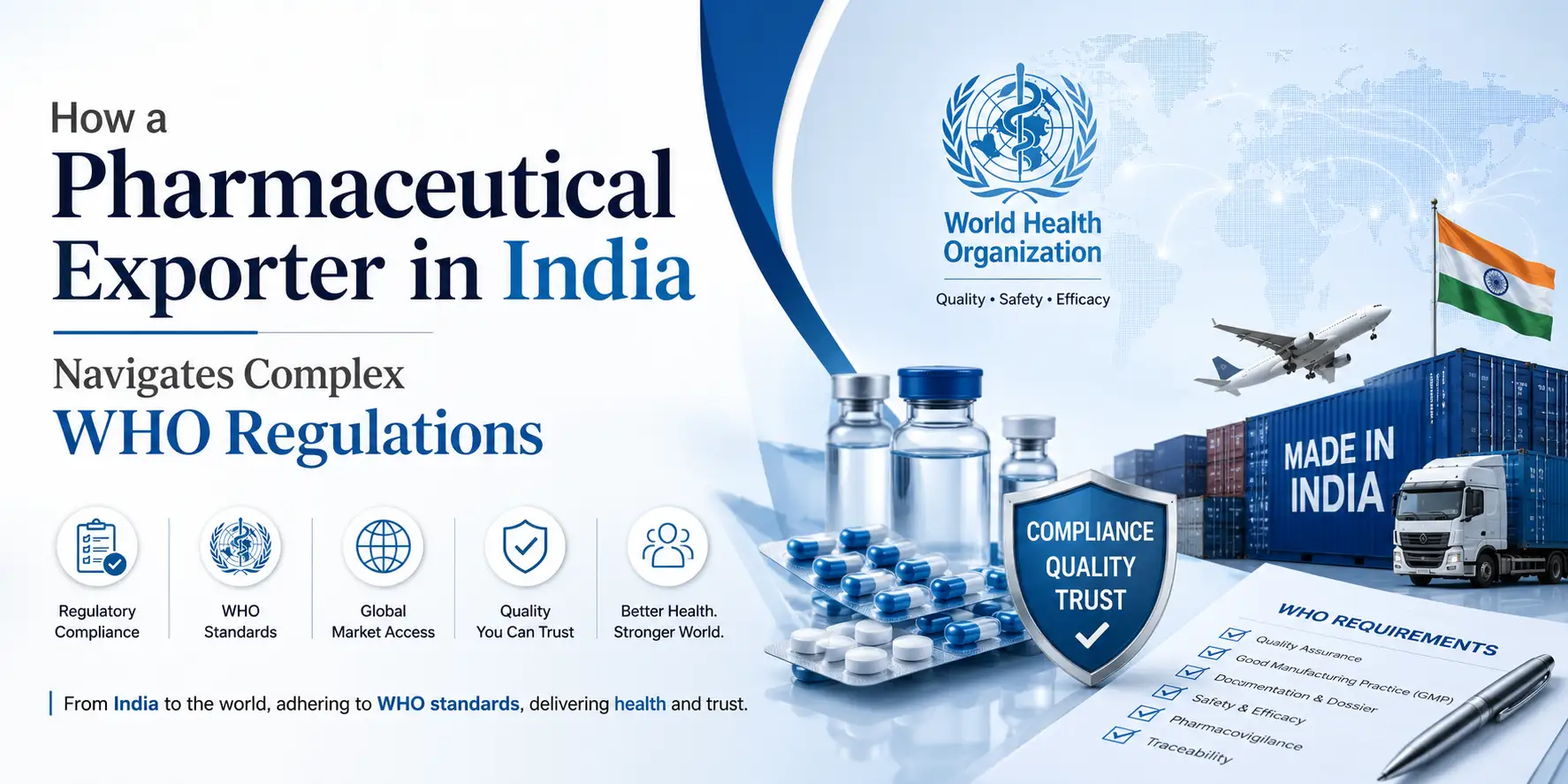
How a Pharmaceutical Exporter in India Navigates Complex WHO Regulations
While India is widely recognised as the global hub for medicine, supplying life-saving drugs across borders requires much more than just high-volume manufacturing capacities. It demands an uncompromising commitment to global patient safety. For a pharmaceutical exporter, navigating international guidelines often feels like a complex maze of strict quality checks.
At Armein Pharmaceuticals, regulatory compliance drives our operations. Named after the German word for guardian, we ensure our pharmaceutical exports from India meet rigorous international standards to deliver healing across Asia, Africa, Latin America, and CIS countries.
Here is how a dedicated pharmaceutical exporter tackles complex World Health Organization (WHO) regulations to maintain zero defects and uncompromised quality.
The Foundation of Global Trust
Hospitals in Kenya and clinics in Peru trust their medicines are safe because of WHO GMP certification. This standard ensures products are consistently produced under strict quality guidelines. For any serious pharmaceutical exporter, maintaining this certification is non-negotiable to minimise cross-contamination and guarantee efficacy.
At Armein Pharmaceuticals, we do not just test for quality at the end of the line. We operate on a Quality by Design (QbD) principle, meaning quality is built directly into the manufacturing blueprint.
Core Pillars of WHO GMP for a Pharmaceutical Exporter
GMP Pillar | Focus Area | Impact on Export Quality |
Premises and Equipment | Walkable false ceilings, GI powder-coated panels, advanced HVAC. | Allows maintenance without disrupting sterile clean zones. |
Materials Management | Strict vetting of raw materials and active pharmaceutical ingredients. | Ensures only pure and safe components enter the production line. |
Quality Control | Depyrogenation tunnels and rigorous batch testing. | Eliminates fever-causing substances before filling even begins. |
Documentation | Traceability from raw material to the final packaged unit. | Provides transparent proof of regulatory compliance for international audits. |
The Regulatory Roadmap in India
Before a pharmaceutical exporter sends products overseas, they must work with the Central Drugs Standard Control Organization (CDSCO). The CDSCO acts as the bridge between Indian manufacturers and global health authorities.
A critical document required here is the Certificate of Pharmaceutical Product (COPP). Recommended by the WHO, it proves the manufacturer complies with GMP and the product is legally permitted for sale.
Navigating this process requires meticulous documentation, including:
- Site master files
- Stability study evaluations
- Comprehensive process validation data
The regulatory landscape recently became more efficient. With CDSCO’s parallel processing introduced in late 2025, a pharmaceutical exporter can apply for COPP certifications while their product license is under review. This accelerates global market entry without skipping compliance steps.
Mastering Compliance for Pharmaceutical Injections
While oral solid doses follow strict rules, sterile parenteral products demand higher precision. Armein Pharmaceuticals specialises in pharmaceutical injections, making flawless regulatory compliance an absolute necessity.
Injections go directly into the bloodstream, bypassing natural defences. A single microscopic defect can be fatal. To overcome these barriers, a top-tier pharmaceutical exporter must invest heavily in advanced infrastructure.
Here is exactly how we maintain zero defects in our injectable lines:
- Grade-A Sterile Environments: Injection filling occurs under stringent Grade A (class 100) conditions. We use HEPA-filtered air and positive pressure differentials to push air out, preventing untreated air from entering the cleanroom.
- Depyrogenation & Sterility: Before filling, glass vials and ampoules pass through tunnels approaching 300°C to destroy pyrogens. We also leverage advanced lyophilization (freeze-drying) to protect delicate formulations and extend shelf life without strict cold storage.
- Advanced Water Systems: A double RO pass system combined with EDI and UV, running in a continuous loop, prevents stagnation and guarantees optimal water quality.
- Unidirectional Process Flows: Dedicated human and material flows completely eliminate cross-contamination risks.
- 100% Visual Inspection: Every ampoule and vial undergoes rigorous inspection to catch microscopic flaws before batch release.
These robust systems transform standard operations into a powerhouse of reliability.
A Dedicated Guardian of Global Health

Adapting to international trade laws is an ongoing journey. A successful pharmaceutical exporter anticipates regulatory changes rather than just reacting. Continuous training and an ingrained quality culture help us meet diverse global demands.
Our mission remains identical whether we are exporting to highly regulated markets, managing complex cold-chain logistics with IoT-enabled data loggers, or providing cost-effective pharmaceutical injections to developing nations. Patient safety always comes first. Unifying innovative manufacturing with rigorous quality assurance ensures our pharmaceutical exports from India safeguard lives globally.
Frequently Asked Questions (FAQs)
How to get WHO GMP certification for pharma exports?
To get WHO GMP certification for pharma exports, apply through the national regulatory authority (CDSCO in India). The process involves submitting a detailed site master file, meeting stringent quality standards, and passing a rigorous joint inspection.
What is a COPP and why does a pharmaceutical exporter need it?
Issued in a WHO-recommended format, a Certificate of Pharmaceutical Product (COPP) acts as a regulatory passport. A pharmaceutical exporter needs it to pass international audits and prove the facility complies with WHO GMP certification standards.
Why do pharmaceutical injections require stricter regulatory compliance?
Pharmaceutical injections go directly into the patient’s veins or muscles. A pharmaceutical exporter must produce them in highly sterile, Grade-A environments to prevent contamination that could pose severe health risks.
How does a pharmaceutical exporter manage differing regulations across countries?
A pharmaceutical exporter manages varying global rules by implementing an adaptable Quality Management System (QMS) based on Quality by Design (QbD). Adhering to top standards like WHO GMP and PIC/S guidelines allows an exporter to customise documentation for requirements across Asia, Africa, and Latin America.